Kubernetes Gateway API vs. Ingress Controllers: A 2025 Guide to Modernizing Service Networking and Traffic Routing
In the early days of Kubernetes, exposing services to the outside world was a binary choice: use a LoadBalancer (expensive and one-to-one) or use NodePort (clunky). Then came Ingress, a revolution that allowed us to consolidate routing rules behind a single entry point.
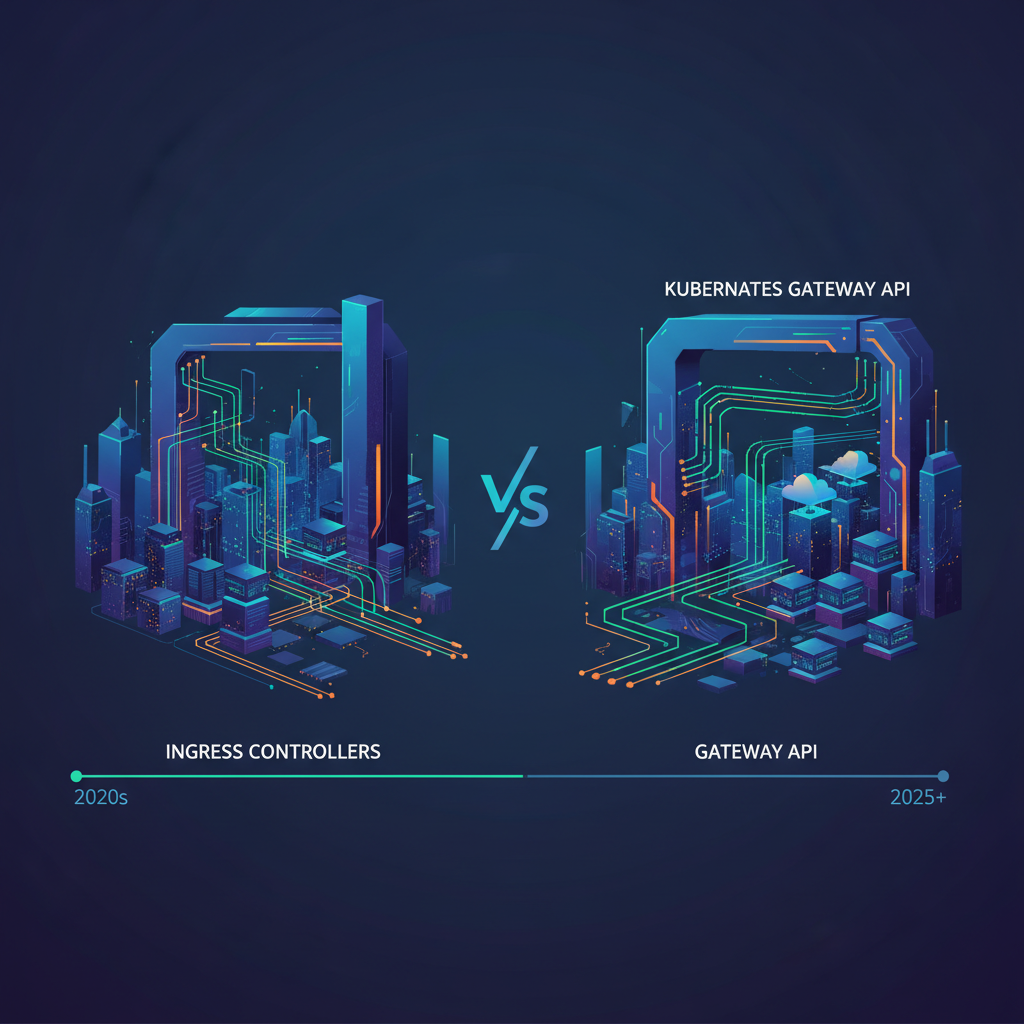
Fast forward to 2025. While the Ingress resource served us well, modern cloud-native architectures have outgrown it. The demand for advanced traffic splitting, cross-namespace routing, and vendor-neutral configurations has paved the way for the Kubernetes Gateway API.
If you are a DevOps engineer or Platform Architect looking to modernize your cluster networking, this guide covers why the industry is shifting, the technical differences between Ingress and Gateway API, and how to implement the latter in your stack today.
The Legacy: The Limitations of Ingress
For years, the Ingress resource was the de facto standard. It provided a simple way to route HTTP/HTTPS traffic to backend services based on hostnames and paths.
However, Ingress suffers from a fundamental design flaw: it is too vague. The specification only covers the basics. As a result, every implementation (NGINX, HAProxy, Traefik, AWS ALB) had to rely on custom annotations to handle advanced configuration.
The “Annotation Hell”
If you wanted to configure a rewrite rule or a rate limit, your YAML looked less like a standardized manifest and more like a vendor lock-in script:
apiVersion: networking.k8s.io/v1
kind: Ingress
metadata:
  name: legacy-app
  annotations:
    # Vendor-specific logic hidden in strings
    nginx.ingress.kubernetes.io/rewrite-target: /$2
    nginx.ingress.kubernetes.io/ssl-redirect: "true"
This approach makes migration difficult. Moving from NGINX to Istio? You have to rewrite every single Ingress resource.
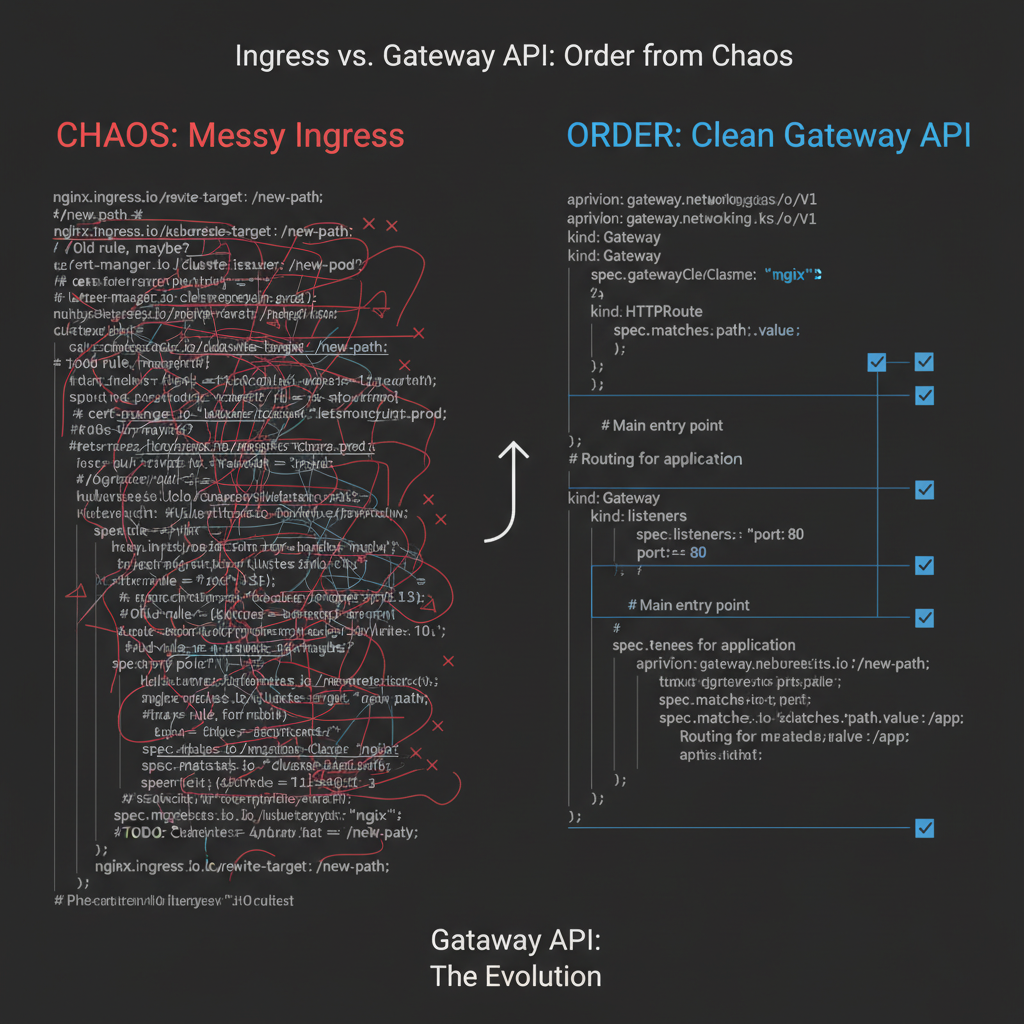
The Future: What is the Gateway API?
The Gateway API is not just “Ingress v2.” It is a complete redesign of service networking in Kubernetes. It was built to be role-oriented, expressive, and extensible.
In 2025, the Gateway API has reached high maturity (GA for major features), with native support from virtually every major mesh and ingress controller (Cilium, Istio, Envoy Gateway, GKE, EKS).
The Role-Oriented Architecture
Unlike Ingress, which combines everything into one object, Gateway API splits responsibilities into three distinct layers:
- GatewayClass: Managed by the Infrastructure Provider. It defines what kind of controller handles the traffic (e.g., “AWS Load Balancer” or “Istio”).
- Gateway: Managed by the Cluster Operator. It defines where the traffic enters (ports, listeners, TLS termination).
- HTTPRoute (and others): Managed by the App Developer. It defines how traffic is routed to services.
Technical Showdown: Ingress vs. Gateway API
Let’s look at the code. We will compare a standard routing setup.
Scenario: Simple Host-Based Routing
The Old Way (Ingress):
apiVersion: networking.k8s.io/v1
kind: Ingress
metadata:
  name: my-ingress
spec:
  rules:
  - host: app.example.com
    http:
      paths:
      - path: /
        pathType: Prefix
        backend:
          service:
            name: my-service
            port:
              number: 80
The Modern Way (Gateway API):
This requires two resources, decoupling the “listener” from the “routing.”
- The Gateway (Operator defines the entry point):
apiVersion: gateway.networking.k8s.io/v1
kind: Gateway
metadata:
  name: my-gateway
  namespace: infra
spec:
  gatewayClassName: istio
  listeners:
  - name: http
    protocol: HTTP
    port: 80
    allowedRoutes:
      namespaces:
        from: All # Allow routes from other namespaces!
- The Route (Developer defines the logic):
apiVersion: gateway.networking.k8s.io/v1
kind: HTTPRoute
metadata:
  name: my-route
  namespace: app-team-a
spec:
  parentRefs:
  - name: my-gateway
    namespace: infra
  hostnames:
  - "app.example.com"
  rules:
  - matches:
    - path:
        type: PathPrefix
        value: /
    backendRefs:
    - name: my-service
      port: 80
Why is the Gateway API version better?
* Cross-Namespace Support: The Gateway is in the infra namespace, but the Route is in app-team-a. Ingress typically struggles with this without complex workarounds.
* Explicit Typing: No annotations. The structure is part of the API schema, meaning kubectl can validate it before you apply it.
Advanced Use Cases: Why Switch in 2025?
The real power of Gateway API becomes apparent when you need to do complex traffic management that previously required a Service Mesh or messy annotations.
1. Canary Deployments (Traffic Splitting)
With Ingress, doing a 90/10 traffic split often required installing a separate tool (like Flagger or Argo Rollouts) that manipulated NGINX annotations. With Gateway API, it is native core functionality.
apiVersion: gateway.networking.k8s.io/v1
kind: HTTPRoute
metadata:
  name: canary-route
spec:
  parentRefs:
  - name: my-gateway
  hostnames: ["myapp.com"]
  rules:
  - backendRefs:
    - name: my-service-v1
      port: 80
      weight: 90
    - name: my-service-v2
      port: 80
      weight: 10
2. Header-Based Matching
Routing based on HTTP headers (e.g., user-type: premium) is a first-class citizen in Gateway API.
  rules:
  - matches:
    - headers:
      - type: Exact
        name: user-type
        value: premium
    backendRefs:
    - name: premium-service
      port: 80
3. Non-HTTP Traffic
Ingress was designed for HTTP. Gateway API creates a standard for TLSRoute, TCPRoute, and UDPRoute. This allows you to manage database exposure or gaming servers using the same API primitives as your web apps.
Migration Strategy: How to Move from Ingress
Migrating a production cluster isn’t an overnight task. Fortunately, Ingress and Gateway API can coexist on the same cluster.
- Install Gateway API CRDs: Ensure your cluster supports the API. Most managed Kubernetes versions (v1.30+) have this by default or as an add-on.
- Select a Controller: Choose a Gateway-compliant controller. Popular choices in 2025 include:
- Envoy Gateway (Pure upstream Envoy)
- Cilium (eBPF based)
- Istio (If you need full mesh capabilities)
- NGINX Gateway Fabric
- Parallel Execution: Create a
Gatewayand anHTTPRoutefor a non-critical service. Point a new DNS entry to the Gateway’s LoadBalancer IP. - Cutover: Once verified, update the primary DNS to point to the new Gateway IP and remove the old Ingress resource.
Conclusion
In 2025, the Ingress resource is in maintenance mode. While it won’t disappear overnight, the ecosystem’s energy is entirely focused on the Gateway API.
The Gateway API offers a cleaner, standardized, and portable way to manage traffic. It solves the multi-tenancy issues that plagued Ingress and brings advanced routing capabilities out of the “annotation shadows” and into the light of a strictly typed API.
For Platform Engineers, the move is inevitable. By adopting Gateway API now, you future-proof your infrastructure and empower your development teams with a self-service networking model that actually scales.
Ready to modernize? Start by auditing your current Ingress annotations and mapping them to Gateway API primitives today.